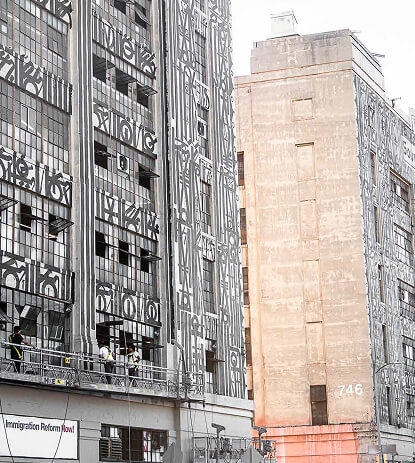
People ask me all the time: what does it say? They look at my symbols and want a translation. But that's not how it works. The alphabet I built isn't a code to crack. It's a feeling to catch. I grew up in LA surrounded by languages — Spanish, Korean, Arabic, Armenian, all the scripts of the city. I saw how writing could separate people or bring them together. So I made something that belongs to nobody and everybody at once. My letters draw from Arabic, Hebrew, Egyptian, Gothic, Native American forms. But they're not any of those things. They're mine. The building in the image — that's a wall in LA, covered in my marks from top to bottom. Workers on scaffolding, the sun hitting the concrete, the whole structure transformed into a page. That's the universal language I'm after. Not something everyone can read, but something everyone can feel. You don't need to know what it says to know it means something.
